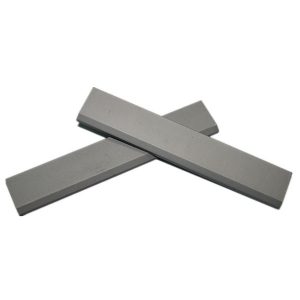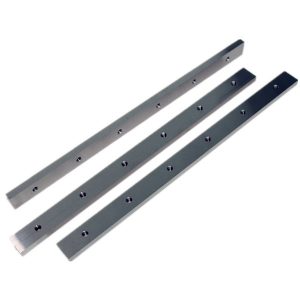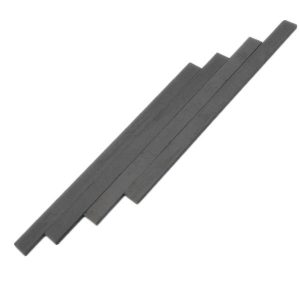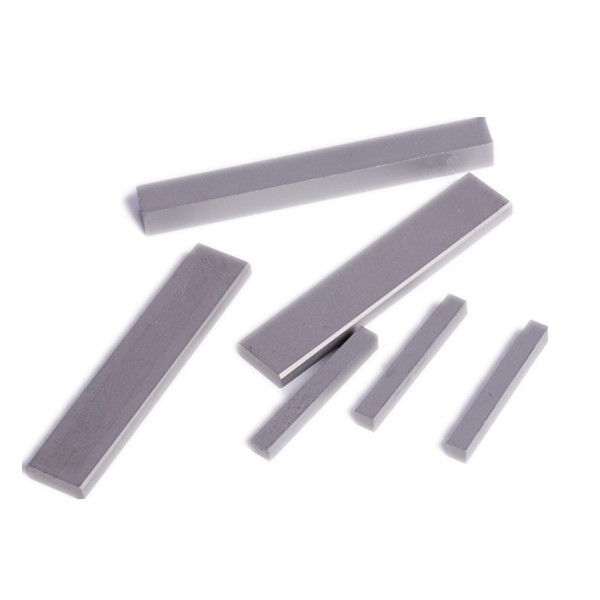
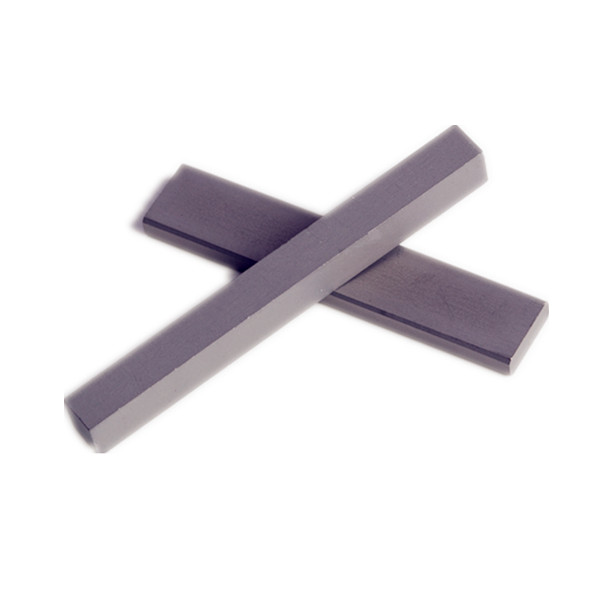
Tungsten carbide plate grades:
| Grade | Composition (%) | Density (g/cm3) | Hardness (HRA) | T.R.S (N/mm²) |
| YG6A | 6%co 94%wc | 14.85 | ≥92.5 | ≥2000 |
| YG8 | 8%co 92%wc | 14.7 | ≥89.8 | ≥2800 |
| YG10X | 10%co 90%wc | 14.35 | ≥91.5 | ≥3600 |
| YG11 | 11%co 89%wc | 14.4 | ≥88.5 | ≥2900 |
| YG15 | 15%co 85%wc | 14 | ≥87.0 | ≥3000 |
| YG20 | 20%co 80%wc | 13.5 | ≥85.5 | ≥2800 |
| YG13X | 13%co 87%wc | 14.2 | ≥90.0 | ≥3200 |
| BT15 | 10%co 90%wc | 14.35 | ≥92.2 | ≥3900 |
| YG6A | Fine grain alloy, good wear resistance. It is suitable for manufacturing forming cutter, wear-resistant parts etc. |
| YG8 | High bending strength, wear resistance lower than YG6A, suitable for manufacturing forming cutter, wear-resistant parts etc. |
| YG11 | |
| YG15 | Suitable for manufacturing punching dies, wear-resistant parts etc. |
| YG20 | High bending strength, suitable for manufacturing progressive dies and other punching dies. |
| YG13X | |
| BT15 | Ultra-fine grain size, High performance, making cutting tools, suitable for cutting ordinary alloy steel, aluminum alloy, heat resistant alloy, cast iron, etc. |
Tungsten carbide plate sizes:
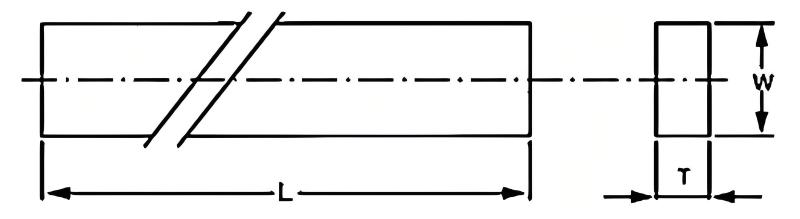
| Length L(mm) |
Width W(mm) |
Thicknes T(mm) |
Length Tolerance(mm) |
Width Toleranee(mm) |
Thickness Tolerance(mm) |
| 330 | 2~3 | 1~3 | +7.0 +3.0 |
+0.4 +0.2 |
+0.35 +0.15 |
| 330 | 3~8 | 1~3 | +7.0 +3.0 |
+0.5 +0.3 |
+0.35 +0.15 |
| 330 | 8~14 | 2~5 | +7.0 +3.0 |
+0.5 +0.3 |
+0.35 +0.15 |
| 330 | 14~34 | 2~11 | +7.0 +3.0 |
+0.6 +0.4 |
+0.5 +0.2 |
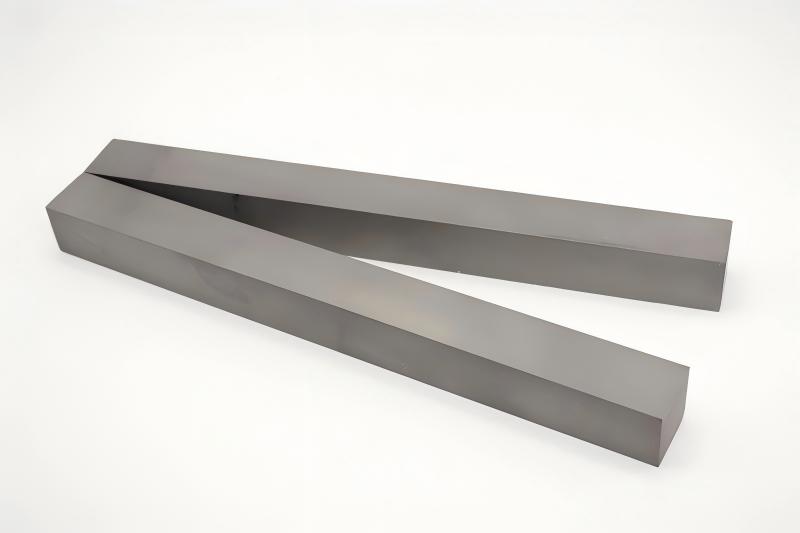
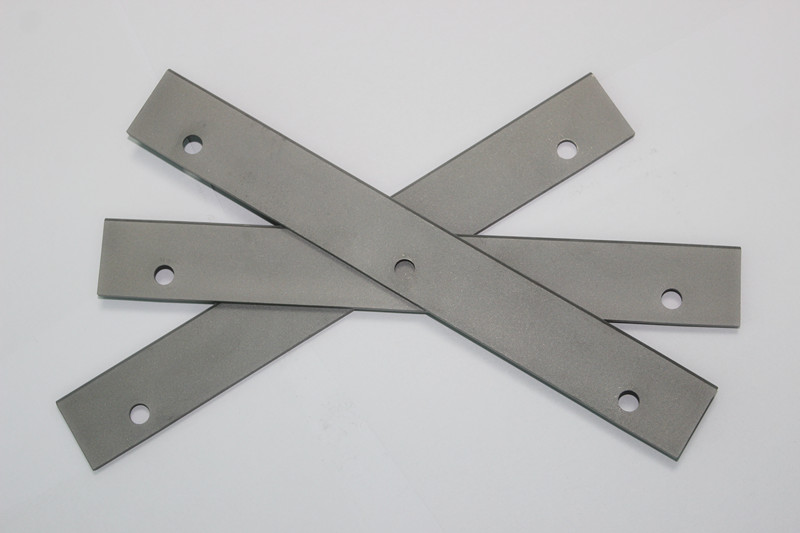
Tungsten carbide plate details:
Primary Applications of Tungsten Carbide Plates:
Tungsten carbide plates are widely utilized in industrial sectors requiring exceptional wear resistance, impact resistance, and stability due to their superior properties. Below are their core application scenarios:
1.Wear-Resistant Components and Liner Plates
This is the most classic application. The plates are directly machined into various wear-resistant parts for harsh working conditions.
Typical Applications: Liner plates for mining machinery, pump components handling abrasive slurries, chute liners in cement plants, and scraper blades for conveyor belts.
Function: Protect main equipment structures from wear caused by high-velocity granular materials (e.g., ores, sand, coal powder), significantly extending service life and reducing downtime for replacements.
2.Stamping and Forming Dies
Blanking Dies: Especially for precision and high-wear applications such as silicon steel sheet punching, electronic component lead frame stamping, and ceramic tile extrusion molds. Tungsten carbide dies offer a service life tens to hundreds of times longer than steel dies, ensuring dimensional stability in long-term production.
Drawing Dies: Used for wire and rod drawing, as well as deep drawing of metal cups. Their low friction coefficient and high surface finish minimize product scratches and improve quality.
Cold Heading and Cold Extrusion Dies: Ideal for forming metals at room temperature, where dies endure extreme pressure and friction.
3.Precision Measurement and Positioning Components
Applications: Gauge blocks, calipers, V-blocks, guide rails, and sliding plates.
Reason: Tungsten carbide exhibits exceptional dimensional stability, wear resistance, minimal thermal expansion, and corrosion resistance. This ensures the long-term accuracy of precision measuring tools and prevents wear-induced gaps in positioning components.
4.Tool Substrates and Blades
While most cutting inserts are pre-shaped, plates serve as raw material for manufacturing these blades.
Applications: Plates are processed via wire cutting or grinding to produce blades for lead cutters, PCB V-CUT knives, and specially shaped shear blades. These tools are used for machining solid wood, particleboard, plastics, cast steel, cast iron, forgings, and stainless steel.
FAQ for tungsten carbide plates:
Q1: What are tungsten carbide plates?
A: Tungsten carbide plates, commonly known as cemented carbide plates, are ultra-hard engineering materials. They are manufactured via powder metallurgy: tungsten carbide (WC) powder is blended with metallic binders (cobalt, nickel or iron), followed by high-temperature sintering. Their microstructure features a composite structure made of rigid tungsten carbide grains embedded in a ductile metallic binder matrix.
Q2: What’s the difference between low-Co and high-Co grades?
A: Low cobalt (3%–8% Co, e.g. YG6, YG8): Higher hardness & wear resistance, brittle, for low-impact high-abrasion work, such as carbide inserts for machining, mining and aggregate, wood working blades, textile wear plates, ceramic mold liners, belt scraper blades, etc.
High cobalt (10%–20% Co, e.g. YG15, YG20): Higher toughness & transverse rupture strength (TRS), lower hardness, for heavy impact, stamping, mining lining, such as Stamping die plates, blanking tool blanks, spring coiling pins and cut-off tools, crusher jaw plates, soil tiller wear strips, etc.
Q3: Are tungsten carbide plates magnetic?
A: Yes, cobalt-bonded carbide plates are weakly magnetic; nickel-binder grades have weaker magnetism. Pure WC without metal binder is non-magnetic. Magnetism is used for factory QC to check consistent cobalt conte.
Q4: How to fix carbide plates onto machine frames? Can I weld directly?
A: Direct arc welding is impossible (high thermal stress causes cracking). Two standard mounting ways:
Silver brazing / copper brazing (most common for wear lining).
Mechanical fastening: pre-drill countersunk holes, bolt to steel base for easy replacement.
Q5: Do tungsten carbide plates require cryogenic treatment?
A: Cryogenic treatment is an optional yet effective post-processing procedure, where plates are kept under liquid nitrogen at -196°C and held for several hours.
Its main benefits include greatly improved wear resistance (up to 35% maximum), removal of residual internal stress, and higher transverse rupture strength. Cryogenic treatment barely changes the macro hardness of tungsten carbide.
This treatment is not required for all grades. It delivers prominent performance improvements for high-cobalt grades such as YG15 and YG20, while low-cobalt and ultra-fine grain carbides gain negligible benefits and are not recommended for cryogenic processing.
Q6: What standard sizes do you stock? What’s the max custom size?
A: Stock blanks: thickness 0.5–200 mm, max single stock piece 300×300 mm. Extra-long strips up to 2500 mm and oversized panels can be produced via custom sintering. Tolerance can reach ±0.001 mm for ground precision plates.
Q7: What’s your MOQ for standard / custom carbide plates?
A: Standard stock sizes: small MOQ, sample order acceptable (1–2 pcs for testing). Non-standard customized shapes require higher MOQ to cover mold & sintering cost.
Q8: What’s your production lead time?
A: Stock ground plates: 2–3 working days.
Standard custom carbide plates: 10–25 days.
Please send us inquiries for quotations and free samples for testing: