
C7 Carbide
I. Definition and Classification Background
C7 Carbide is a classic grade within the US ANSI carbide classification system. It belongs to the C5–C8 series dedicated to steel machining and corresponds to the ISO P10–P20 standards, serving as a mainstream carbide substrate for the semi-finishing of steel components. The ANSI C classification is based primarily on application scenarios rather than fixed, mandatory compositional standards. It is broadly divided into two categories: C1–C4 grades are cubic-carbide-free WC-Co alloys suitable for machining cast iron and non-ferrous metals (corresponding to ISO K-class); C5–C8 grades incorporate additives such as TiC and TaC and are designed specifically for steel cutting (corresponding to ISO P-class), effectively mitigating crater wear.
The properties of the C-series grades follow a consistent gradient: from C5 to C8, cobalt content decreases while the proportion of cubic carbides increases, resulting in progressively higher hardness and wear resistance but gradually lower toughness. C7 falls between C6 and C8; precisely positioned for steel semi-finishing, it achieves an optimal balance between wear resistance and impact toughness. It is suitable for medium-load cutting operations involving slight interruptions, offering versatility that far exceeds other grades in the same series. Note that formulations for C7 vary among manufacturers; for mass-production applications, please refer to the manufacturer’s official material specifications.
II. Chemical Composition and Physical Properties
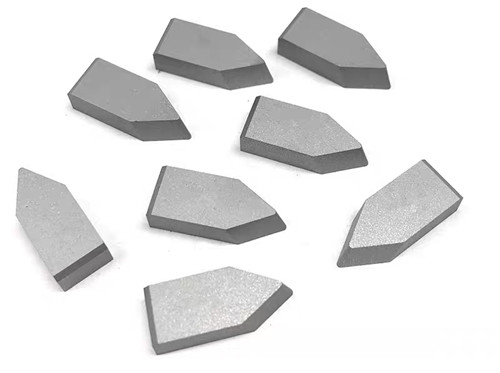
C7 carbide utilizes tungsten carbide (WC) as the hard matrix and cobalt (Co) as the binder phase. The cobalt content is maintained at 5%–8%—lower than that of the C5 and C6 grades used for roughing—while 10%–20% of cubic carbides (such as TiC, TaC, and NbC) are added. TiC serves as the key functional component, inhibiting diffusion and fusion wear during high-temperature steel cutting and preventing cratering damage. TaC and NbC enhance high-temperature hardness and thermal shock stability, ensuring the cutting edge remains stable under high-temperature operating conditions. It features stable core physical property ranges and is suitable for semi-finishing operations: a hardness of HRA 91.0–92.5 with excellent wear resistance; a density of 12.5–13.5 g/cm³ (lower than standard WC-Co alloys); and a transverse rupture strength of 1800–2400 MPa, capable of withstanding moderate cutting loads and minor impacts. Its refined grain structure balances cutting-edge sharpness with structural integrity; it retains good hot hardness at temperatures up to 800°C, making it suitable for medium-to-high-speed cutting applications.
III. Core Technical Characteristics and Application Limitations
The core advantage of C7 is its exceptional resistance to crater wear; when machining carbon steel or alloy steel at medium-to-high speeds, its tool life far exceeds that of standard WC-Co alloys of similar hardness. It offers a superior balance of properties: compared to the C6 semi-roughing grade, it provides longer wear life and more stable machining precision; compared to the C8 finishing grade, it offers better toughness, tolerating light interrupted cuts and vibrations during thin-walled part machining without being prone to edge chipping or breakage. Additionally, the material exhibits excellent thermal stability—resisting softening or deformation during prolonged continuous cutting and maintaining dimensional accuracy—making it ideal for automated mass production.
The operational boundaries and limitations of this grade are clearly defined: first, it has poor resistance to heavy impact, making it unsuitable for heavy-duty cutting, machining of forged surfaces (black skin), or severe interrupted cutting; second, its material compatibility is limited—it is suitable only for ferrous steels. Machining cast iron can cause vibration and edge chipping due to brittle chip formation, while machining non-ferrous metals fails to leverage its core performance advantages, resulting in poor cost-effectiveness compared to specialized grades.
IV. Application Scenarios and Grade Benchmarking
C7 is primarily used for the semi-finishing of steel components, including 45# steel, alloy structural steel, quenched and tempered steel, and low-hardness stainless steel. It is suitable for processes such as CNC semi-finish turning, form turning, copy turning, and standard thread turning, as well as light-load face milling and shallow slot milling. It is designed for mass production scenarios involving medium cutting speeds, moderate depths of cut, and the absence of severe interrupted cutting. Uncoated C7 substrates are rarely used in the industry; they primarily serve as base materials for PVD or CVD coatings (such as TiN or Al₂O₃), which significantly enhance cutting speeds and tool life. They are also used to a limited extent for small, precision mold inserts requiring high wear resistance and low impact.
Regarding grade benchmarking, within the ANSI system, C5 is suited for roughing, C6 for semi-roughing, C7 for semi-finishing, and C8 for high-precision finishing. The Chinese YT15 grade closely resembles C7 in performance and can serve as a substitute, though there are subtle differences in composition and properties. Mainstream commercial benchmark substrates include Kennametal’s K25 and Seco’s TP2500, both of which cover the P10–P20 performance range.
V. Selection Summary
C7 is a classic cemented carbide substrate for the semi-finishing of steel components. Its core value lies in a specialized compositional design that addresses the primary wear issues associated with cutting steel, effectively balancing wear resistance and toughness. Selection should adhere to three principles: prioritize coated C7 tools to suit mainstream high-efficiency machining; strictly define the workpiece material and operating conditions to mitigate the risk of tool failure; and, for high-volume or high-precision machining, verify the manufacturer’s material specifications to ensure a precise match between parameters and operating conditions.
Our company is among China’s top ten tungsten carbide manufacturers. Should you require cemented carbide products, please contact us.