
Cryogenic Treatment of Tungsten Carbide: Process, Benefits & Applications
Tungsten carbide combines high hardness, high strength, and excellent wear resistance, making it widely used in cutting tools, cold-working dies, and various wear-resistant components. However, during the cooling phase of sintering, the significant difference in thermal expansion coefficients between the WC hard phase and the Co binder phase results in substantial residual internal stress. Furthermore, the phase composition and distribution of the cobalt binder directly determine the material’s strength-toughness balance. As a supplementary post-processing technique, cryogenic treatment effectively optimizes microstructure and stress states, serving as a crucial method for enhancing the service performance of Tungsten carbide.
I. Definition of Cryogenic Treatment of Tungsten Carbide
Cryogenic treatment is a process in which a workpiece is exposed to an environment below -100°C (industrial applications typically utilize liquid nitrogen, with treatment temperatures around -196°C) to regulate its microstructure and stress field through a period of constant-temperature holding.
Compared to conventional cold treatment (temperatures around -80°C), cryogenic treatment involves lower temperatures that more effectively drive solid-state phase transformations in the binder phase and adjust the distribution of internal residual stresses. This leads to macroscopic improvements in hardness, wear resistance, and dimensional stability, while reducing the risk of cracking during service. It is important to note that, unlike the “quenching followed by cryogenic treatment” sequence used for ferrous materials, Tungsten carbide is produced via powder metallurgy sintering and does not undergo quenching; cryogenic treatment is typically performed after sintering (or after sintering and tempering).
II. Typical Cryogenic Treatment Processes of Tungsten Carbide
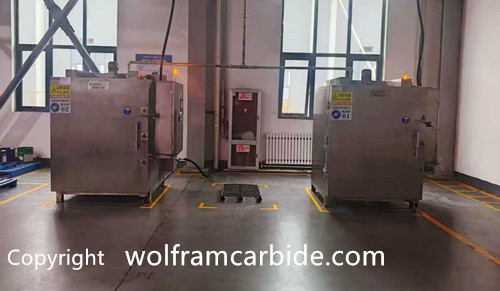
Cryogenic treatment consists of three core stages: cooling, holding, and warming. Process parameters must be tailored to the specific alloy grade and workpiece dimensions, with the fundamental principle being the avoidance of thermal shock cracking caused by rapid temperature changes.
During the cooling stage, the material is typically cooled to the target cryogenic temperature at a slow rate of 0.5–2°C/min. For large or complex-shaped die components, industrial processes often employ a stepped cooling approach (e.g., -60°C → -120°C → -190°C), incorporating holding periods at each temperature level to further minimize the risk of thermal stress. The holding stage involves maintaining a constant temperature in a liquid nitrogen (liquid or vapor) environment for a period ranging from several hours to 24 hours, depending on the specific grade and workpiece dimensions. For instance, fine-grained Tungsten carbide rods are typically held for 2 to 12 hours. When large cold-heading dies undergo stepped cooling, each stage involves a holding period of 4 to 8 hours to ensure temperature uniformity throughout the workpiece and provide optimal conditions for the phase transformation of the binder phase.
During the reheating stage, the temperature is raised slowly back to room temperature to prevent rapid heating from inducing secondary thermal stresses. For products requiring high microstructural stability, a supplementary low-temperature tempering step may be performed after reheating to further stabilize the phase transformation products and the stress state.
The performance benefits of cryogenic treatment depend significantly on the specific carbide grade; not all tungsten carbides experience across-the-board performance improvements. Consequently, parameters such as temperature, duration, number of cycles, and tempering protocols must be optimized based on the intended application.
III. What Tungsten Carbide Products Are Suitable for Cryogenic Treatment?
Cryogenic treatment is primarily targeted at products requiring superior wear resistance, dimensional stability, crack resistance, and extended service life. Typical categories include:
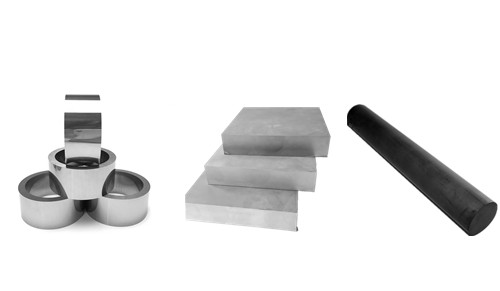
1. Tungsten carbide Rods: Residual internal stresses in as-sintered rods can easily lead to cracking during subsequent processing or service. Cryogenic treatment allows for the release and redistribution of stresses in ultra-fine-grained rods, significantly extending the service life of heavy-duty cutting tools made from them. While a standalone cryogenic process typically yields a 30%–150% increase in service life, the ultimate performance gain usually results from the synergistic effects of cryogenic treatment, grinding processes, and coatings.
2. Tungsten carbide Plates: Widely used for blanking dies and wear-resistant structural components, these plates benefit from cryogenic treatment through the elimination of internal stresses accumulated during sintering and cooling. This reduces the risk of cracking and deformation during machining processes such as wire-cut EDM and grinding, thereby improving yield rates and dimensional accuracy.
3. Tungsten carbide Cold-Heading Dies: These components are subjected to repeated impact and friction during service. Internal tensile stresses formed during sintering and cooling often lead to cracking or edge chipping. Cryogenic treatment can induce the transformation of a portion of the face-centered cubic (fcc) α-Co phase into the hexagonal close-packed (hcp) ε-Co phase, optimizing the balance between toughness and wear resistance while simultaneously reducing internal tensile stresses and introducing compressive stresses at the surface. Industrial data indicates that the average service life of YG20 cold-heading dies increases by more than 15% following optimized processing.
4. Tungsten carbide anvils: Used in synthetic diamond production, these components demand extremely high strength and fatigue resistance. Experimental data shows that for BTN10 grade anvils, cryogenic treatment raises microhardness from 1610 HV to 1689 HV while simultaneously improving fatigue resistance.
5. Tungsten carbide bushings: These are widely used in high-wear, heavy-load applications such as mining, hydraulics, and wire drawing. Due to their thick-walled annular structure, residual stresses are unevenly distributed between the inner and outer surfaces after sintering, making the inner wall prone to fatigue cracking and failure via material spalling. Cryogenic treatment can homogenize internal stresses and induce compressive stress on the inner wall, thereby enhancing wear resistance and dimensional stability while effectively extending service life.
6. Tungsten carbide preforms: As-sintered blanks often harbor significant residual sintering stresses, making them susceptible to edge chipping, cracking, and dimensional drift during subsequent finishing processes like wire-cut EDM and grinding. Applying cryogenic treatment prior to finishing allows for the early release of stress and stabilization of the cobalt phase microstructure; this reduces the scrap rate during machining while simultaneously improving the dimensional accuracy and wear resistance of the finished product.
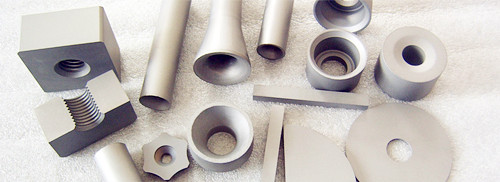
In addition, products such as Tungsten carbide inserts, drill bits, nozzles, and wire-drawing dies can also achieve performance optimization through cryogenic treatment.
IV. Patterns of Performance Changes After Cryogenic Treatment
1.Hardness Changes
Cryogenic treatment enhances hardness primarily by driving the martensitic transformation of the cobalt phase and refining the microstructure of the binder phase. For conventional WC-Co Tungsten carbides, the overall increase in Rockwell hardness (HRA) typically falls within the 0.5–1 HRA range, with a relative change rate usually under 1%; not all grades exhibit an increase in hardness. Claims circulating in the industry regarding a “20% increase in hardness” stem from isolated extreme test results or specific processing conditions and lack general industrial reference value.
2.Residual Stress Regulation
In the as-sintered state, the cobalt phase regions of Tungsten carbides are typically under tensile stress, which is a primary trigger for micro-crack initiation. Cryogenic treatment effectively adjusts stress distribution by reducing tensile stress levels within the cobalt phase while simultaneously introducing compressive stress at the workpiece surface; this is a key mechanism by which cryogenic treatment enhances the product’s crack resistance and fatigue life.
3.Improved Wear Resistance
Cryogenic treatment improves wear resistance in two ways: by enhancing the wear resistance of the binder phase itself through cobalt phase transformation, and by optimizing the stress state to reduce the tendency of WC particles to spall during service. Depending on cobalt content, grain size, wear conditions, and processing parameters, the improvement in wear resistance generally ranges from 10% to 50%. Combining cryogenic treatment with low-temperature tempering can further stabilize the microstructure and reinforce wear resistance. 4. Impact on Transverse Rupture Strength and Toughness
There is no universal pattern regarding the effect of cryogenic treatment on the transverse rupture strength and fracture toughness of Tungsten carbides; the outcome depends heavily on alloy composition, grain size, and processing parameters. Under certain processing conditions, phase transformation of the cobalt phase may lead to a slight decline in toughness and transverse rupture strength; however, performance improvements can be achieved through parameter optimization—for instance, the transverse rupture strength of YG20 alloy can increase by nearly 10% under optimized conditions. Findings regarding changes in the impact toughness of low-cobalt Tungsten carbides also vary, requiring assessment based on specific grades.
Overall, cryogenic treatment involves a distinct trade-off in performance characteristics: improvements in hardness and wear resistance often come at the cost of some toughness. Consequently, processing parameters must be tailored to the primary failure modes of the specific product.
V. Summary of Cryogenic Treatment of Tungsten Carbide
Cryogenic treatment is a simple, environmentally friendly, and cost-effective post-processing technique. By subjecting materials to controlled cooling and holding at temperatures between -100°C and -196°C, it enables the regulation of the cobalt phase, the relief of residual stresses, and the optimization of the microstructure.
For Tungsten carbide products requiring high precision and durability—such as rods, plates, cold-heading dies, and anvils—cryogenic treatment effectively eliminates internal stresses, enhances crack resistance and wear resistance, and extends service life. However, the actual effectiveness depends heavily on the compatibility between processing parameters and alloy grades. Since there is an inherent trade-off between different performance metrics, no single “universally optimal” process exists. In practical applications, the best approach should be determined through process trials that consider the product’s service conditions and performance targets, thereby balancing performance gains against production costs.
Our company is among China’s top ten tungsten carbide manufacturers. Should you require cemented carbide products, please contact us.