
Was ist Sinterkarbid?
Was ist Sinterkarbid? Woraus wird Sinterkarbid hergestellt? Sinterkarbid ist eine pulvermetallurgisch hergestellte Legierung aus einem oder mehreren feuerfesten Karbidpulvern (Hartmetallbuchsen, Titankarbid usw.) als Hauptbestandteil und Metallpulver (Kobalt, Nickel usw.) als Bindemittel. Es wird hauptsächlich für die Herstellung von Hochgeschwindigkeits-Schneidwerkzeugen und Schneidwerkzeugen für harte und zähe Materialien sowie für die Formen für die Kaltbearbeitung, Messgeräte und hochverschleißfeste Teile die nicht durch Stöße und Vibrationen beeinträchtigt werden.
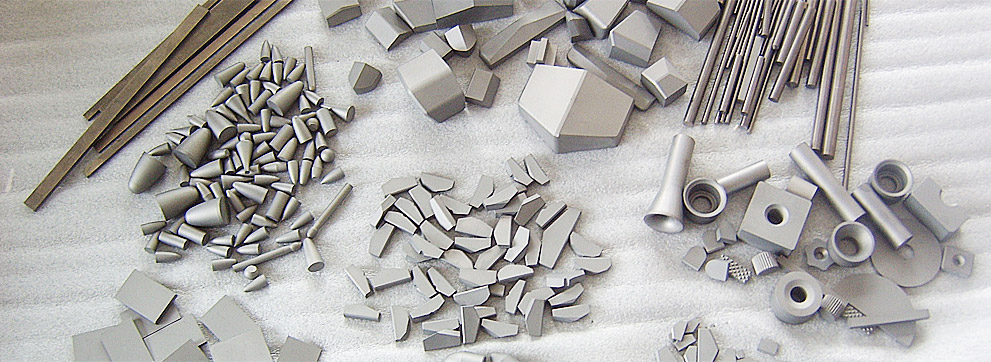
1. Merkmale von Sinterkarbid:
⑴ Hohe Härte, Verschleißfestigkeit und rote Härte Die Härte von Hartmetall kann 86~93HRA bei Raumtemperatur erreichen, was 69~81HRC entspricht. Es kann eine hohe Härte bei 900~1000℃ beibehalten und hat eine ausgezeichnete Verschleißfestigkeit. Im Vergleich zu Schnellarbeitsstahl kann die Schnittgeschwindigkeit 4~7 mal höher sein, die Lebensdauer ist 5~80 mal länger, und es können harte Materialien mit einer Härte von bis zu 50HRC geschnitten werden.
⑵ Hohe Festigkeit und Elastizitätsmodul Die Druckfestigkeit von Hartmetall beträgt bis zu 6000 MPa, und der Elastizitätsmodul beträgt (4~7)×105MPa, was beides höher ist als bei Schnellarbeitsstahl. Aber seine Biegefestigkeit ist niedrig, im Allgemeinen 1000 ~ 3000MPa
⑶ Gute Korrosions- und Oxidationsbeständigkeit Im Allgemeinen kann es atmosphärischer, saurer, alkalischer und anderer Korrosion sehr gut widerstehen und ist nicht leicht zu oxidieren.
⑷ Kleiner linearer Ausdehnungskoeffizient Bei der Bearbeitung sind Form und Größe stabil.
⑸ Die geformten Produkte werden nicht mehr bearbeitet oder nachgeschliffen Aufgrund der hohen Härte und Sprödigkeit von Sinterkarbid werden pulvermetallurgisch geformte und gesinterte Produkte nicht mehr geschnitten oder nachgeschliffen. Wenn eine Nachbearbeitung erforderlich ist, können nur elektrische Bearbeitungsverfahren wie Funkenflug, Drahtschneiden, elektrolytisches Schleifen oder das Schleifen mit speziellen Schleifscheiben eingesetzt werden. Produkte bestimmter Spezifikationen, die in der Regel aus Hartmetall hergestellt werden, werden gelötet, geklebt oder mechanisch auf den Werkzeug- oder Formkörper geklemmt, um sie zu verwenden.
2. Die üblicherweise verwendeten Sinterkarbide werden je nach Zusammensetzung und Leistungsmerkmalen in drei Kategorien unterteilt:
Wolfram-Kobalt, Wolfram-Titan-Kobalt und Wolfram-Titan-Tantal (Niob). Am weitesten in der Produktion verbreitet sind Wolfram-Kobalt- und Wolfram-Titan-Kobalt-Hartmetalle.
⑴ Wolfram-Kobalt-Hartmetall Die Hauptbestandteile sind Wolframkarbid (WC) und Kobalt. Die Sorte wird durch den Code YG (die chinesischen Pinyin-Initialen für "hart" und "Kobalt") angegeben, gefolgt vom prozentualen Kobaltanteil. YG6 steht beispielsweise für ein Wolfram-Kobalt-Sinterkarbid mit einem Kobaltgehalt von 6%, und der Wolframkarbidgehalt ist WC = 1-WCo = 94%.
⑵ Wolfram-Titan-Kobalt-Sinterkarbid Die Hauptbestandteile sind Wolframkarbid (WC), Titankarbid (TiC) und Kobalt. Die Sorte wird durch den Code YT (die chinesischen Pinyin-Initialen für "hart" und "Titan") angegeben, gefolgt von dem prozentualen Anteil an Titankarbid. YT15 steht beispielsweise für ein Wolfram-Titan-Kobalt-Sinterkarbid mit einem Titankarbidgehalt von WTiC = 15%.
⑶ Wolfram-Titan-Tantal (Niob)-Hartmetall Diese Art von Hartmetall wird auch als allgemeines Hartmetall oder universelles Hartmetall bezeichnet. Seine Hauptbestandteile sind Wolframkarbid (WC), Titankarbid (TiC), Tantalkarbid (TaC) oder Niobkarbid (NbC) und Kobalt. Die Marke wird durch den Code YW (das erste chinesische Pinyin der beiden Zeichen "hart" und "wan") gefolgt von einer Ordnungszahl dargestellt.
3. Vorteile:
Hartmetall besitzt eine hohe Härte, Festigkeit, Verschleißfestigkeit und Korrosionsbeständigkeit. Es ist als “Industrie-Zahn” bekannt und wird zur Herstellung von Schneidwerkzeugen, Messern, Kobaltwerkzeugen und verschleißfesten Teilen verwendet. Es wird häufig in der Militärindustrie, Luft- und Raumfahrt, mechanischen Bearbeitung, Metallurgie, Ölförderung, Bergbauwerkzeugen, elektronischer Kommunikation, im Bauwesen und in anderen Bereichen eingesetzt. Mit der Entwicklung nachgelagerter Industrien steigt die Marktnachfrage nach Hartmetall weiter an. Darüber hinaus werden die zukünftige Herstellung von Hightech-Waffen und -Geräten, der Fortschritt der Spitzenwissenschaft und -technologie sowie die rasante Entwicklung der Kernenergie die Nachfrage nach Hartmetallprodukten mit hohem Technologiegehalt und hoher Qualitätsstabilität stark erhöhen.
4. Häufig gestellte Fragen (FAQ) zu Hartmetall:
(1) Was sind die Kernleistungskennzahlen für Hartmetall? Wie wird seine Qualität bewertet?
Antwort: Die Kernleistungsindikatoren und Qualitätsbewertungskriterien sind wie folgt: Der Schwerpunkt liegt auf vier Schlüsselindikatoren – Härte (HRA 82–93,6), Dichte (11,0–15,0 g/cm³, je nach Zusammensetzung), Biegebruchfestigkeit und Zähigkeit. Darüber hinaus müssen metallographische Parameter wie Porosität und ungebundener Kohlenstoffgehalt überprüft werden. Ein Produkt gilt als qualifiziert, wenn es frei von sichtbaren Fehlern (wie Delamination, Rissen oder Graten) ist und den Anforderungen der Norm ISO 4489:2019 entspricht.
(2) Wie beeinflusst der Kobaltgehalt in Hartmetall die Produktleistung?
Antwort: Kobalt (Co) dient als Hauptbindemittel in Hartmetall; sein Gehalt bestimmt unmittelbar das Verhältnis zwischen der Härte und der Zähigkeit des Produkts: ① Ein höherer Kobaltgehalt (z. B. 8%–12%) führt zu einer höheren Zähigkeit und einer besseren Schlagfestigkeit, wobei die Härte und die Verschleißfestigkeit leicht abnehmen können. Diese Zusammensetzung eignet sich für Anwendungen, bei denen Stöße auftreten können, wie z. B. Grobbearbeitung und unterbrochenes Schneiden. ② Ein niedrigerer Kobaltgehalt (z. B. 3%–6%) sorgt für eine höhere Härte und Verschleißfestigkeit, führt jedoch zu einer geringeren Zähigkeit. Diese Zusammensetzung eignet sich für Anwendungen mit extrem hohen Anforderungen an die Verschleißfestigkeit, wie z. B. Feinbearbeitung und Hochgeschwindigkeitsschneiden. Der spezifische Kobaltgehalt kann je nach den jeweiligen Arbeitsbedingungen angepasst werden.
(3) Welche Korrosionsbeständigkeit und Hochtemperaturbeständigkeit besitzt Hartmetall? In welchen extremen Umgebungen ist es für den Einsatz geeignet?
Antwort: ① Hohe Temperaturbeständigkeit: Hartmetall kann seine Härte bei hohen Temperaturen von 800 °C bis 1000 °C beibehalten – weit über die Fähigkeiten von Schnellarbeitsstahl hinaus – und eignet sich somit für Anwendungen, die Hochtemperaturzerspanung, Metallurgie und ähnliche Prozesse beinhalten. ② Korrosionsbeständigkeit: Die Korrosionsbeständigkeit von Hartmetall hängt von seinem Bindemittel und seinen Legierungselementen ab; kobaltbasierte Hartmetalle bieten eine moderate Korrosionsbeständigkeit, während nickelbasierte Hartmetalle eine überlegene Beständigkeit bieten und für den Einsatz in korrosiven Umgebungen geeignet sind, wie sie in der chemischen und maritimen Industrie vorkommen. ③ Hinweis: Hartmetall ist nicht für eine längere Exposition gegenüber hohen Temperaturen und stark oxidierenden Umgebungen geeignet (z.B. Temperaturen über 1000 °C in Gegenwart von Sauerstoff), da dies zu oxidativem Versagen führen kann.
(4) Welche Prüfnormen gibt es für Hartmetallprodukte? Welche spezifischen Posten werden hauptsächlich geprüft?
Antwort: Derzeit halten sich die nationalen Normen an die ISO 4489:2019, Hartmetalle — Regeln für Prüfung und Untersuchung. Die primären Prüfkategorien umfassen fünf Bereiche: ① chemische Zusammensetzung (Hauptmetallgehalt, Gesamt-Kohlenstoffgehalt, Sauerstoffgehalt usw.); ② physikalische und mechanische Eigenschaften (Dichte, Härte, Biegefestigkeit; und, wo erforderlich, Koerzitivfeldstärke, magnetische Sättigung, Schlagzähigkeit usw.); ③ metallografische Struktur (Porosität, freier Kohlenstoff, Mikrostruktur usw.); ④ Abmessungen (geometrische Abmessungen, Form- und Lagetoleranzen usw.); ⑤ visuelle Qualität (Fehlen von Defekten wie Delamination, Risse, Abplatzen, Grate, Oxidation usw.).
Unser Unternehmen gehört zu den zehn führenden Unternehmen in China. Sinterkarbid-Hersteller. Sollten Sie Produkte aus Hartmetall benötigen, wenden Sie sich bitte an Kontaktieren Sie uns.