
Tungsten carbide VS diamond: Material Properties, Applications, and Operating Conditions
Comparison of Tungsten Carbide VS Diamond: Material Properties, Applications, and Operating Conditions
Tungsten carbide and diamond are both core super-hard, wear-resistant materials in the industrial sector, widely used in cutting tools, drilling equipment, and precision components. While both are renowned for their high hardness and wear resistance, they differ significantly in composition, properties, and suitable operating conditions. This article systematically compares the two materials—covering definitions, properties, applications, and material selection logic—to provide a reference for industrial use.
I. Tungsten Carbide vs Diamond: Basic Definitions and Chemical Composition
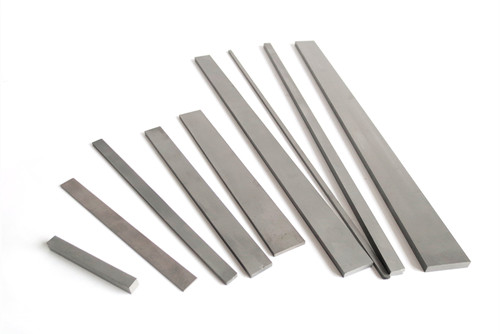
Tungsten carbide is a cermet-based composite hard material formed from tungsten and carbon. Pure tungsten carbide is rarely used directly in industry; instead, metals such as cobalt or nickel serve as a binder phase, and the material is sintered at high temperatures to form cemented carbide, thereby balancing hardness and toughness. Its core component is tungsten carbide (WC), which features a hexagonal crystal lattice structure; in industrial cemented carbides, tungsten typically accounts for 80%–97% of the mass, with high-tungsten grades exceeding 90%. The metal binder phase fills the spaces between tungsten carbide grains, effectively enhancing structural stability. Tungsten carbide is chemically stable at room temperature and exhibits excellent resistance to acid and alkali corrosion.
Diamond is an elemental crystal composed of pure carbon; it belongs to the isometric crystal system and forms a three-dimensional cross-linked structure through perfect tetrahedral covalent bonds. While natural diamonds originate from high-temperature, high-pressure environments deep within the Earth’s crust, industrial applications rely primarily on synthetic diamonds. These fall into two main categories: High-Pressure High-Temperature (HPHT) synthetic diamonds (including single-crystal and Polycrystalline Diamond, or PCD) and Chemical Vapor Deposition (CVD) diamonds. Diamond is chemically inert—reacting with almost no acids or alkalis—and is the hardest known natural or synthetic material, standing in stark contrast to graphite, which is also composed of carbon but possesses a soft, layered structure.
II. Tungsten Carbide vs Diamond: Core Physical and Mechanical Properties
Differences in properties dictate the specific roles of these two materials. The following section compares them across four aspects: hardness, toughness, thermal conductivity and heat resistance, and overall machinability. 2.1 Hardness and Wear Resistance
Diamond possesses the highest hardness of all materials, with a Mohs hardness of 10 and a Vickers hardness of 8,000–10,000 HV; it is capable of machining the vast majority of hard, brittle materials while offering exceptional wear life and machining precision. Tungsten carbide (cemented carbide) has a Mohs hardness of 9–9.5 and a Vickers hardness typically ranging from 1,400 to 1,800 HV (the theoretical hardness of pure tungsten carbide is approximately 2,200 HV). Although significantly lower than that of diamond, this hardness is more than double that of high-speed steel (600–800 HV), making it suitable for conventional metal cutting and wear-resistant components while offering an excellent cost-performance ratio.
2.2 Toughness and Impact Resistance
Toughness is a distinct advantage of tungsten carbide. The fracture toughness of WC-Co cemented carbide ranges from 8 to 12 MPa·m¹ᐟ²; toughness improves with higher cobalt content and coarser grain sizes. The metallic binder phase effectively absorbs impact energy, making the material resistant to chipping or cracking under mechanical impact and cyclic loading. In contrast, natural and single-crystal diamonds have a fracture toughness of only 2–3 MPa·m¹ᐟ². While polycrystalline diamond (PCD) achieves a fracture toughness of 6–10 MPa·m¹ᐟ² through binder-phase toughening, this remains significantly lower than that of cemented carbide. Consequently, diamond-based materials generally exhibit weaker impact resistance and struggle to withstand vibrations or sudden external forces—a key reason why they are unsuitable for heavy-duty, harsh operating conditions.
2.3 Thermal Conductivity and Heat Resistance
Diamond boasts superior thermal conductivity; natural single-crystal diamond has a thermal conductivity of 1,000–2,200 W/(m·K)—more than five times that of pure copper—allowing it to rapidly dissipate heat generated during cutting and prevent thermal deformation of the workpiece. Industrial PCD has a thermal conductivity of 450–700 W/(m·K), which also far exceeds that of cemented carbide. However, in oxygen-rich environments, diamond undergoes graphitization at temperatures of 700–800°C, resulting in a drastic reduction in hardness. Tungsten carbide has a melting point of approximately 2870°C and can withstand high temperatures of 1200°C for extended periods in an oxygen-free environment; however, its thermal conductivity is relatively low (80–110 W/(m·K)), leading to poor heat dissipation and heat accumulation during cutting, which accelerates wear.
2.4 Comprehensive Machinability and Cost
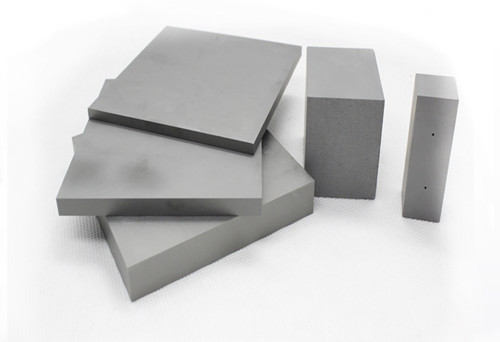
Tungsten carbide blanks can be formed directly via powder metallurgy sintering, followed by finishing processes such as grinding and electrical discharge machining (EDM). The manufacturing process is mature, and material consistency is high, making it suitable for the mass production of standardized cutting tools and molds at a controllable cost. In contrast, diamond possesses an extremely low coefficient of friction and enables superior surface finishes, offering irreplaceable advantages in ultra-precision machining; however, it is difficult to shape and expensive to produce, limiting mass production and restricting its use primarily to high-end precision applications.
III. Tungsten Carbide vs Diamond: Major Industrial Applications
3.1 Tungsten Carbide: The Versatile “Industrial Teeth”
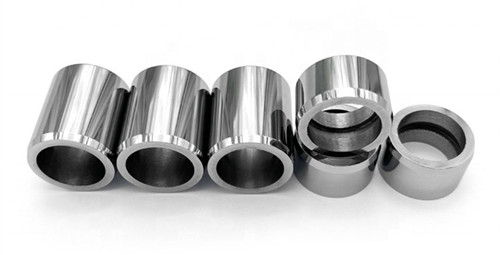
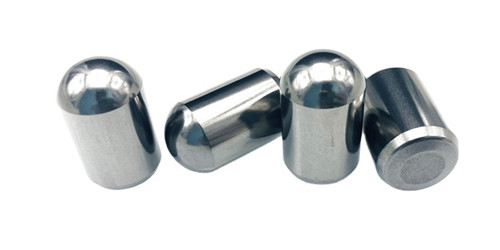
Thanks to an optimal balance of hardness, toughness, and cost, tungsten carbide is the most widely used material. In metal cutting, tungsten carbide insert is extensively employed for turning, milling, drilling, and tapping operations on materials such as steel, cast iron, and aluminum alloys, proving capable of handling routine machining tasks that involve high frequency and impact loads. In the mining and construction sectors, tungsten carbide buttons serve as the core material for rock drill bits, coal mining picks, concrete crushing tools, and wear-resistant parts, effectively withstanding continuous vibration and impact. Additionally, it is widely used in precision stamping dies, tungsten carbide bushing for mechanical bearings, valve seals, and wear-resistant metallurgical components, helping to reduce material loss and replacement costs.
3.2 Diamond: A Specialized Precision Material for Extreme Conditions
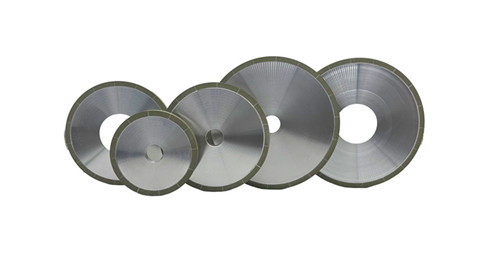
Diamond dominates the fields of high-end precision machining and specialized operating environments due to its extreme hardness and precision capabilities. First, it is a core material for ultra-precision cutting tools used to machine hard and brittle materials—such as ceramics, glass, cemented carbide, sapphire, and single-crystal silicon—achieving micron- to nanometer-level precision for applications in optical components, semiconductor substrates, and precision molds. Second, in deep-well oil drilling and hard rock drilling, diamond drill bits leverage their exceptional wear resistance to achieve significantly longer service lives under steady-state operating conditions free from severe impact. Furthermore, diamond is utilized in semiconductor heat-dissipation substrates, thermal interface materials for high-power electronics, and precision polishing abrasives and pastes to achieve mirror-like, ultra-fine finishes. Synthetic diamond grinding wheels and cutting discs are also essential tools for the high-precision cutting and grinding of hard, brittle materials.
IV. Tungsten Carbide vs Diamond: Comparison of Optimal Operating Conditions
4.1 Preference for Tungsten Carbide
Tungsten carbide is the preferred choice in applications involving continuous vibration, mechanical shock, or alternating loads. In scenarios such as mining, geotechnical drilling, heavy-duty rough cutting, and concrete breaking—where frequent external impacts occur—diamond is highly susceptible to edge chipping and failure, whereas tungsten carbide maintains its structural integrity thanks to its high toughness. When prioritizing mass production and cost control, tungsten carbide offers a far superior cost-performance ratio compared to diamond, making it suitable for large-scale standardized tools, molds, and wear-resistant components. It should be noted, however, that tungsten carbide undergoes oxidation and decarburization in oxygen-rich environments above 600°C; its high-temperature oxidation resistance is not superior to that of diamond, so high-temperature, oxygen-rich conditions are not its strong suit. Its true advantage regarding high-temperature performance lies in stable, long-term operation under oxygen-free conditions.
4.2 Preference for Diamond
Diamond is the mandatory choice for processing ultra-hard, brittle materials or performing ultra-precision machining. Materials such as ceramics, monocrystalline silicon, and sapphire cause rapid wear and insufficient precision in tungsten carbide tools; only diamond enables efficient, high-precision processing with minimal material loss. Precision machining characterized by steady loads and an absence of impact—such as semiconductor chip dicing, optical mirror polishing, and the dressing of ultra-precision molds—represents the ideal operating environment for diamond. Furthermore, in scenarios demanding exceptional hardness, precision, and thermal conductivity without frequent impact—such as high-end electronic thermal management, ultra-hard cutting and grinding, and steady-state deep-well drilling—the material advantages of diamond are fully realized.
V. Tungsten Carbide vs Diamond: Conclusion
Tungsten Carbide vs Diamond: Tungsten carbide and diamond do not simply represent a relationship where one is superior to the other; rather, they are two distinct types of superhard materials with complementary properties and differing application scenarios. Tungsten carbide has become the standard choice for general industrial applications due to its toughness, impact resistance, mature manufacturing technology, and cost-effectiveness; meanwhile, diamond—characterized by extreme hardness, an ultra-low coefficient of friction, and superior precision—is the material of choice for high-end precision engineering and specialized operating conditions. The key to industrial material selection lies in moving beyond a one-sided focus on hardness; instead, a comprehensive assessment of the workpiece material, impact loads, precision requirements, and economic costs is essential to leverage the unique strengths of each material and truly enhance production efficiency and product quality.
Our company is among China’s top ten tungsten carbide manufacturers. Should you require cemented carbide products, please contact us.