
Is tungsten carbide stronger than tungsten
Yes, tungsten carbide is stronger than tungsten. However, more accurately, the “tungsten carbide” commonly used in engineering is mostly tungsten carbide-based cemented carbide, such as WC-Co cemented carbide, not pure WC ceramic phase. In terms of hardness, compressive strength, wear resistance, and stiffness, tungsten carbide surpasses pure tungsten in all aspects: its Vickers hardness is 4 to 8 times that of pure tungsten (1600–2400 HV vs 300–400 HV), its Mohs hardness reaches 9–9.5 (pure tungsten is 7.5), its compressive strength is approximately 2.7 GPa (pure tungsten’s sintered compressive strength is approximately 1000–1400 MPa), its elastic modulus is more than 30% higher, and its wear life can be more than 10 times that of pure tungsten. However, pure tungsten has a higher melting point (3422°C vs 2870°C) and higher density, making it irreplaceable in ultra-high temperature and high specific gravity applications. The following is a detailed analysis from the perspectives of composition, data comparison, and product applications.
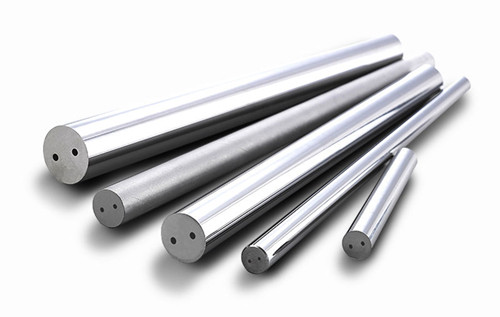
I. The Fundamental Difference Between Tungsten Carbide and Tungsten
Chemically, pure tungsten (W) is a metallic element with atomic number 74, belonging to the body-centered cubic crystal system; while tungsten carbide (WC) is a compound formed by tungsten and carbon in a 1:1 atomic ratio, belonging to the hexagonal crystal system. This fundamental structural difference determines the difference in their properties.
Pure tungsten is bonded by metallic bonds, allowing for relative slip between atoms, thus possessing typical characteristics of metallic materials—a certain degree of plasticity and toughness, but relatively limited hardness. Tungsten carbide, on the other hand, is primarily bonded by a mixture of covalent and metallic bonds. The carbon and tungsten atoms form an independent hexagonal crystal compound, significantly hindering dislocation movement, making the material extremely hard, but also more brittle.
In terms of density, pure tungsten has a density of 19.25 g/cm³, while tungsten carbide has 15.63 g/cm³, making tungsten carbide approximately 19% lighter than pure tungsten. This is because the introduction of carbon atoms alters the crystal lattice arrangement; although tungsten atoms have a large mass, the unit cell volume of the compound increases more significantly.
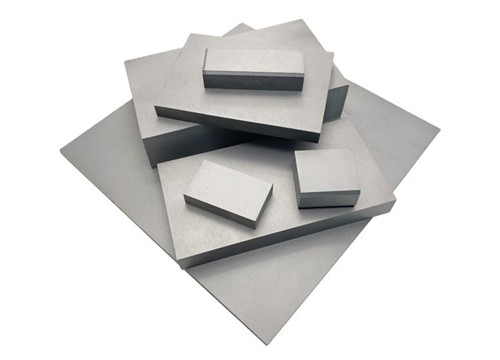
II. Data Comparison: Why Tungsten Carbide is Stronger
Judging whether a material is “strong” requires a comprehensive evaluation from multiple dimensions, including hardness, compressive strength, wear resistance, and elastic modulus. The following is a direct comparison of key indicators.
The most significant difference lies in hardness. Pure tungsten has a Mohs hardness of approximately 7.5 and a Vickers hardness between 300 and 400 HV; tungsten carbide has a Mohs hardness of 9 to 9.5 and a Vickers hardness as high as 1600 to 2400 HV, with single-crystal basal planes even reaching 2600 HV. In other words, tungsten carbide is 4 to 8 times harder than pure tungsten, approaching the level of diamond (Mohs 10). In industrially used WC-Co cemented carbide, the Rockwell hardness can reach HRA 85 to 93, far exceeding any pure metal.
Compressive strength is also superior. The ultimate compressive strength of tungsten carbide is approximately 2.7 GPa. The tensile strength of pure tungsten in the sintered state is only 550 to 1000 MPa, and even after work hardening through wire drawing, it only reaches about 2500 MPa; its compressive strength is about 1000 to 1400 MPa. Under compressive stress conditions such as compression and rolling, tungsten carbide has a significantly better load-bearing capacity than pure tungsten.
The elastic modulus reflects the material’s stiffness. The Young’s modulus of tungsten carbide is about 530 to 700 GPa, while that of pure tungsten is about 410 GPa, a difference of about 30% to 70%. This means that under the same stress conditions, tungsten carbide exhibits smaller elastic deformation and better dimensional stability, which is crucial for precision cutting tools and molds.
Wear resistance is a core advantage of tungsten carbide. Wear resistance is positively correlated with hardness, and the wear life of tungsten carbide is typically several times, even tens of times, that of pure tungsten. In high-abrasive wear scenarios such as mining drilling and metal cutting, the service life of tungsten carbide parts far exceeds that of pure tungsten products.
It’s important to note that “strong” does not equate to “tough.” The fracture toughness of pure tungsten is typically around 5 to 15 MPa√m, while that of tungsten carbide cemented carbide is around 8 to 20 MPa√m (depending on cobalt content). While tungsten carbide is harder and more wear-resistant, it is also more brittle and prone to chipping under impact loads. Therefore, industrially, cobalt is usually used as a binder phase to produce WC-Co cemented carbides, achieving a balance between hardness and toughness.
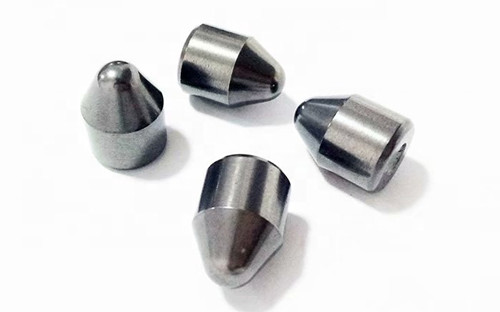
III. Main Products and Applications of Tungsten Carbide
Tungsten carbide is rarely used directly in its pure compound form. In most cases, it is sintered with binder metals such as cobalt and nickel using powder metallurgy to form cemented carbides, commonly known as “tungsten steel.” Common product grades include the YG series (cobalt-based), YT series (tungsten-cobalt-titanium-based, used for cutting steel), and YW series (general-purpose).
Cutting tools are the largest application area for tungsten carbide. Carbide cutting tools such as lathe tools, milling cutters, drills, and reamers account for approximately half of global tungsten carbide consumption. Taking YG8 as an example, its hardness reaches HRA 89 and its bending strength is approximately 2000 MPa. It can perform high-speed cutting of cast iron, non-ferrous metals, and non-metallic materials, with cutting speeds 3 to 5 times faster than high-speed steel tools.
Tungsten carbide teeth are widely used in mining and engineering drilling. PDC composite plates used in oil drilling, ball teeth in mining drill bits, and hobbing rings in tunnel boring machines all use tungsten carbide as the wear-resistant matrix. In these working conditions, the abrasiveness of the rock is extremely high; pure tungsten parts can hardly withstand the stress, while the lifespan of tungsten carbide teeth can be more than 10 times that of pure metals.
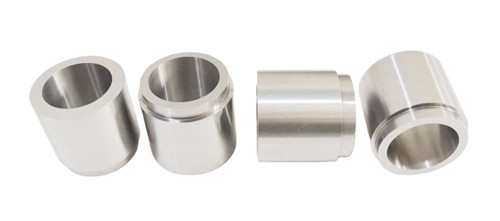
Wear-resistant parts are also widely used in dies. Products such as wire drawing dies, cold heading dies, stamping dies, nozzles, sealing rings, and plungers require long-term maintenance of dimensional accuracy, making tungsten carbide the preferred choice due to its high hardness and low coefficient of friction. For example, the lifespan of tungsten carbide wire drawing dies is 50 to 100 times that of alloy steel dies.
In addition, tungsten carbide is used to manufacture high-end consumer goods and medical products such as watch cases, jewelry, and surgical instruments, utilizing its high hardness to achieve scratch resistance and long-lasting shine.
Applications of Pure Tungsten
While pure tungsten is not as hard as tungsten carbide, its unique high-temperature properties make it irreplaceable in many fields.
High-temperature applications are the primary domain of pure tungsten. Pure tungsten has a melting point of 3422°C, the highest of all pure metals, approximately 550°C higher than tungsten carbide’s 2870°C. Even at extreme temperatures exceeding 2000°C, pure tungsten can maintain a strength of over 100 MPa, while tungsten carbide begins to oxidize and its hardness rapidly decreases above 500°C. Therefore, products such as incandescent lamp filaments, electron tube cathodes, high-temperature furnace heating elements and heat shields, and rocket nozzle throat liners must use pure tungsten or tungsten alloys.
Radiation shielding and weighting utilize the high density of pure tungsten. With a density of 19.25 g/cm³, close to that of gold and uranium, pure tungsten possesses excellent X-ray and gamma-ray shielding capabilities for the same volume, making it widely used in medical radiotherapy collimators and nuclear industry shielding components. Simultaneously, its high density makes it an ideal material for aircraft control surface counterweights, racing car balance weights, and fishing sinkers.
Electronic and vacuum electronic devices rely on the low expansion and high electrical and thermal conductivity of pure tungsten. The coefficient of thermal expansion of pure tungsten is only 4.5 × 10⁻⁶/K, which matches well with some hard glass and is commonly used in electron pins, glass-sealed leads, and high-temperature heat sinks; however, its coefficient of thermal expansion does not match that of silicon, making it unsuitable for direct use as a heat sink in semiconductor packaging.
IV. Is tungsten carbide stronger than tungsten? Conclusion
Returning to the initial question—is tungsten carbide stronger than tungsten? The answer depends on the definition of “strong.” If measured by hardness, compressive strength, wear resistance, and stiffness, tungsten carbide indeed surpasses pure tungsten in every aspect: its Vickers hardness is 4 to 8 times that of pure tungsten, its compressive strength is about 2 to 5 times higher, its elastic modulus is more than 30% higher, and its wear life can be more than 10 times that of pure tungsten. The introduction of carbon atoms fundamentally changes the lattice bonding mode, which is the intrinsic reason for the leap in performance of tungsten carbide.
However, pure tungsten is not an obsolete material. It has the highest melting point of all metals (3422°C) and a higher density, giving it irreplaceable advantages in ultra-high temperature conditions, radiation shielding, and electronic packaging. In short, tungsten carbide wins in “hardness” and “wear resistance,” while pure tungsten wins in “high temperature resistance” and “high specific gravity.” The key to industrial selection is not which is stronger, but choosing the most suitable material based on the temperature, load, wear, and impact characteristics of the specific operating conditions.
Our company is among China’s top ten tungsten carbide manufacturers. Should you require cemented carbide products, please contact us.