
How to melt tungsten carbide ?
How to melt tungsten carbide? Tungsten carbide (WC), known as the “teeth” of modern industry, is renowned for its unparalleled hardness and wear resistance. However, transforming it from a solid to a liquid state—i.e., achieving the melting process—is an extremely challenging task in the fields of materials science and high-temperature technology. This article aims to systematically explain the fundamental principles, existing technical approaches, and core challenges of melting tungsten carbide. All content is based on verified engineering practices and scientific literature, strictly avoiding any unsubstantiated speculation.
I. Extreme Challenges in Melting Tungsten Carbide
Melting tungsten carbide is not a simple heating process; its difficulties are rooted in its inherent physical and chemical properties:
Extremely High Melting Point: The melting point of tungsten carbide is 2870°C ± 50°C, a temperature far exceeding that of most common metals and refractory materials. This requires heating equipment capable of generating and maintaining a local or overall high-temperature environment significantly above 3000°C to overcome heat loss and achieve complete melting.
High-Temperature Chemical Activity and Decomposition Risk: Near its melting point, tungsten carbide is not completely inert. It may undergo decarburization and decomposition in a vacuum or inert atmosphere, forming tungsten (W) and graphite carbon, according to the reaction: WC → W + C. This process alters the material composition, causing the obtained melt to deviate from the ideal stoichiometric ratio and severely affecting final properties.
Limitations of Container Materials: Almost no solid material can exist stably for extended periods above 2900°C without reacting with molten tungsten carbide. A few high-melting-point ceramics like zirconia (ZrO₂) and thoria (ThO₂) can be used with difficulty but risk contaminating the melt or being eroded. This makes “containerless melting” technologies the mainstream choice.
Solidification and Crystallization Control: When molten tungsten carbide cools, direct solidification typically forms coarse, brittle crystals with low practicality. Therefore, the melting process is often not intended for casting but rather serves purposes like single crystal growth, coating preparation, or specific reactions.
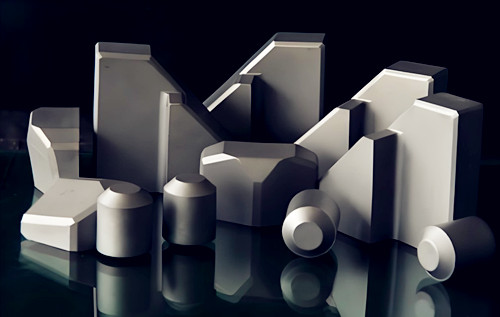
II. Main Technical Methods for Melting Tungsten Carbide
Based on the above challenges, the following high-tech methods are employed in industry and laboratories to melt tungsten carbide:
1.Arc Melting Method
This is the most classic and reliable method for melting bulk tungsten carbide.
Principle: Under the protection of high-purity inert gas (typically argon), a direct or alternating current arc is used to generate a sustained high-temperature plasma arc between the cathode (usually a tungsten electrode) and the anode (the tungsten carbide raw material). Temperatures can exceed 3500°C, causing rapid melting of the raw material.
Key Design: Employs a “water-cooled copper crucible.” The copper crucible itself is not heat-resistant, but forced water cooling on its back creates a solidified tungsten carbide “skull” layer on the inner wall surface in contact with the melt. This skull acts as an isolation layer, protecting the copper crucible from being melted through while avoiding contamination of the melt by container material, achieving “non-contact” melting.
Application: Mainly used for producing high-purity tungsten carbide ingots, melting tungsten carbide-based alloys (e.g., adding precursors of binder phases like cobalt or nickel), or for remelting and recycling scrap material.
2.Electron Beam Melting Method
This method is conducted in an ultra-high vacuum environment, yielding extremely high-purity melts.
Principle: In an environment with a vacuum better than 10⁻² Pa, a high-voltage electric field accelerates thermions emitted from a filament to high energies. These are focused by electromagnetic lenses into a high-speed electron beam that bombards a tungsten carbide feed rod placed in a water-cooled copper crucible. The kinetic energy of the electron beam is almost entirely converted into heat, instantly raising the local temperature at the bombardment point above 3500°C to achieve melting.
Advantages:
Ultra-High Vacuum:** Effectively prevents oxidation and decarburization and can volatilize and remove some low-melting-point metallic impurities (e.g., iron, aluminum) from the raw material.
Precise Control: The power, scanning path, and focus of the electron beam can be precisely programmed for controlled directional melting, zone refining, or layer-by-layer addition.
Application: Producing ultra-high-purity tungsten carbide single crystals or large-grain materials for scientific research, and raw materials for specialty coatings with extremely high purity requirements.
3.Plasma Melting Method
Utilizes a high-temperature plasma jet as a heat source, offering flexibility and efficiency.
Principle: A working gas (Ar, H₂, N₂, or mixtures) is ionized via arc discharge or high-frequency induction, forming a plasma jet with temperatures ranging from 5000-20000°C. This jet is directed at tungsten carbide powder or compacts, causing rapid melting.
Forms:
Transferred Arc: The arc forms between the electrode and the workpiece (tungsten carbide), offering high energy transfer efficiency, suitable for larger-scale melting.
Non-Transferred Arc: The arc forms between the electrode and the nozzle, and the plasma is blown out, suitable for spraying, melting powders, etc.
Application: Primarily used for producing spherical tungsten carbide powder via the plasma rotating electrode process (for 3D printing, thermal spraying, etc.) and for surface cladding or repair. The raw material melts in the plasma torch under centrifugal force and atomizes, rapidly solidifying to form dense spherical powder.
4.Laser and Focused Solar Melting
These methods involve local melting using high-energy beams.
Principle: Utilizing high-power laser beams (e.g., CO₂ laser, fiber laser) or solar beams focused by large parabolic mirrors to concentrate extremely high energy density on a tiny area of the tungsten carbide surface, achieving local melting or even vaporization.
Characteristics: Extremely fast heating rates, small melt pool size, narrow heat-affected zone.
Application: Mainly used for precision machining (e.g., drilling, cutting, micro-welding) and surface modification (e.g., laser cladding for wear-resistant coatings), not for large-scale melting. Their essence is selective melting for material removal or fusion.
III. Core Process Control Points for Melting
Regardless of the method, successfully melting tungsten carbide requires strict control of the following parameters:
Atmosphere and Vacuum Level: Strict isolation from oxygen, typically using >99.999% high-purity argon or a vacuum better than 10⁻² Pa to suppress oxidation and excessive decarburization.
Energy Input and Temperature Gradient: Precise control of input power and heating/cooling rates to prevent material cracking due to thermal stress. For single crystal growth, establishing a precise temperature gradient is necessary.
Chemical Composition Stability: Compensating for carbon loss at high temperatures by controlling the atmosphere’s carbon potential (e.g., introducing trace hydrocarbons) or using carbon-supersaturated raw materials to maintain the stoichiometric ratio of WC.
Solidification Control: Rapid cooling typically leads to brittleness. Controlling the cooling rate through zone melting or directional solidification techniques can improve grain structure and even obtain oriented microstructures.
IV. Why “Sintering” is More Common than “Melting” in Industry
Despite the existence of the aforementioned melting technologies, powder metallurgy sintering remains the absolute mainstream in the industrial production of cemented carbide products (e.g., cutting tools, molds). Tungsten carbide micron powder is mixed with metal binders like cobalt, pressed into shape, and then subjected to liquid-phase sintering in a hydrogen or vacuum environment at 1400-1500°C. At this temperature, the binder melts and fills the gaps between tungsten carbide particles via capillary action, achieving densification, while the tungsten carbide particles themselves do not melt. This method offers low energy consumption, controllable cost, ease of producing complex shapes, and excellent comprehensive mechanical properties.
Therefore, tungsten carbide melting technology primarily serves special fields: producing high-purity or large single-crystal materials, manufacturing specialty spherical powders, recycling and purifying scrap material, and preparing coatings for certain extreme conditions.
Conclusion:
Melting tungsten carbide is a complex engineering feat that pushes the limits of material temperature resistance and energy technology. It is not merely a physical process of transforming solid to liquid but a comprehensive test of high-temperature science, vacuum technology, atmosphere protection, and solidification science. From the industrial roar of water-cooled copper crucible arc furnaces to the extreme vacuum of electron beam melting chambers, to the dancing metal droplets in plasma torches, humanity has tamed one of the hardest substances through these ingenious technologies, opening new possibilities for its application in cutting-edge scientific and technological fields. However, the choice of technology always serves the application’s purpose. Understanding the difference between melting and sintering represents the scientific trade-off material engineers make between cost, performance, and feasibility.
Our company is among China’s top ten cemented carbide manufacturers. Should you require cemented carbide products, please contact us.
 EN
EN  ES
ES  PT
PT  DE
DE  IT
IT  PL
PL  FR
FR  TR
TR  RU
RU  JA
JA  KO
KO