
Analysis of the application of cemented carbide in high-pressure roller mills (HPGR)
Cemented carbide is a key material for the core wear-resistant components of high pressure roller mills (HPGRs). Its application level and consumption scale directly reflect the maturity of HPGR technology and its market penetration. This article combines the specific application forms, core performance requirements, and latest technological advancements of cemented carbide in HPGRs to conduct multi-dimensional calculations and analyses of its consumption, providing a reference for industry development.
I. Core Application Forms of Cemented Carbide in High Pressure Roller Mills
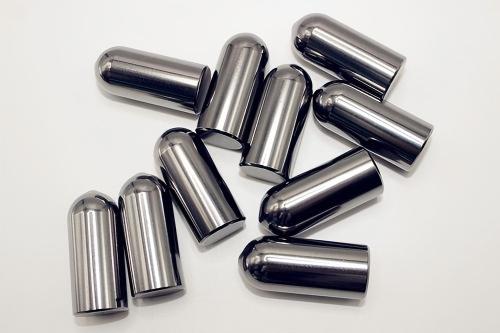
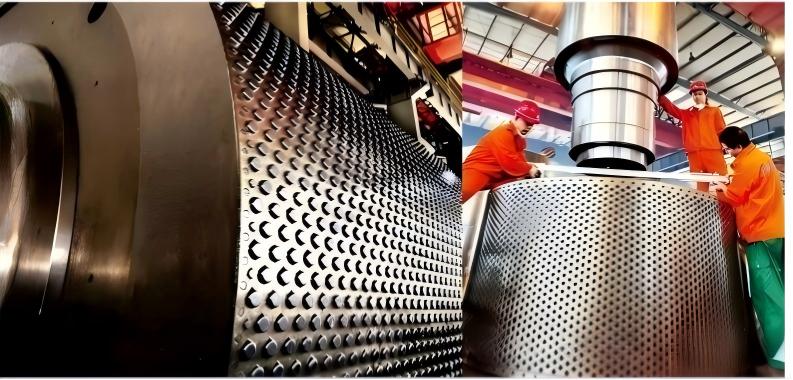
In the structural design of high pressure roller mills, the core application scenario of cemented carbide is the fabrication of wear-resistant studs (also known as tungsten carbide studs) and their embedding into the surface of the roller sleeve (roller surface), forming a “stud roller surface” structure. This structure has become the mainstream solution for high pressure roller mill roller surface technology and is recognized as the most advanced technical path in the industry.
(1) Application Forms and Core Advantages
Cemented carbide studs mostly adopt a cylindrical structure and are embedded into the roller sleeve substrate surface in a matrix-like, dense arrangement through processes such as interference fit, hot-setting, or adhesive bonding. During equipment operation, fine powder material fills the gaps between the roller pins under high pressure, forming a “material pad” that effectively protects the roller sleeve substrate from direct wear. The exposed carbide roller pins, with their high hardness, directly withstand the extrusion, impact, and abrasion of the material.
Compared to traditional welded roller surfaces, the service life of carbide roller surfaces is significantly improved, increasing by more than 10 times. In practical applications, the carbide roller surfaces from Humboldt AG in Germany have an actual service life of approximately 8,000 hours. In advanced domestic applications, under iron ore crushing conditions, the designed service life of this type of roller surface has reached 12,000 to 18,000 hours, significantly reducing equipment downtime maintenance costs.
(2) Matching Requirements for the Roller Sleeve Substrate
The performance of carbide roller pins is closely related to the performance of the roller sleeve substrate material. The substrate must possess sufficiently high compressive strength and wear resistance to provide stable support for the roller pins while resisting material abrasion itself. Related research indicates that roller sleeves made from Fe-C-V-Mo-Cr series high-strength wear-resistant steel, produced through centrifugal casting and subsequent heat treatment, exhibit wear resistance 3 to 15 times that of ordinary high-chromium cast iron. This fully meets the working requirements of carbide studs, ensuring they do not fall off or loosen. Furthermore, some industry research has explored the use of an insert casting process, directly casting carbide balls into a wear-resistant cast iron or bainitic ductile iron matrix to form a composite roller surface structure, further enhancing the overall wear resistance of the roller surface.
II. Material Performance Requirements and Technological Progress of Carbide Studs
As a core component in high-pressure roller mills that directly bears wear, the material performance of carbide studs directly determines the service life of the roller surface, the stability of equipment operation, and overall economic efficiency. Therefore, strict requirements are placed on their performance, and the industry is continuously promoting related technological optimization.
(1) Material Composition and Application Challenges
Currently, the mainstream material for carbide studs used in high-pressure roller mills is tungsten-cobalt (WC-Co) carbide. In practical applications, a core technical challenge exists: to prevent premature breakage of the studs under high pressure and impact loads, grades with higher cobalt content must be selected. However, increasing the cobalt content leads to a decrease in the hardness of the cemented carbide, thereby sacrificing its wear resistance, corrosion resistance, and thermal fatigue resistance. From a microscopic wear mechanism perspective, stud wear mainly manifests as leaching loss of the cobalt binder phase and abrasive wear of the WC hard phase by the material, both of which jointly affect the service life of the studs.
(2) Performance Optimization Directions and Practical Results
To address the above application challenges, the core optimization direction in the industry focuses on adjusting the composition and microstructure of the cemented carbide. By optimizing the WC grain size, WC content, and binder phase type, a balance between hardness and toughness is achieved, thereby improving the overall performance of the studs. Long-term field testing data shows that studs made from cemented carbide with medium WC grain size (1.0-2.0 μm) and low cobalt content (5-9 vol.%) exhibit a 27% improvement in durability compared to conventional studs, with a testing duration of 26,000 hours, verifying the feasibility of this optimized solution. Meanwhile, related technology research and development is ongoing, focusing on developing novel tungsten-cobalt cemented carbides that combine high hardness, high strength, excellent impact resistance, thermal fatigue resistance, and corrosion resistance, further expanding their application scenarios.
(3) Exploration and Application of Alternative Materials
In addition to traditional WC-Co cemented carbides, the industry is also exploring the application of alternative materials. Among them, TiC-based high-manganese steel-bonded cemented carbides have been gradually applied to wear-resistant structural components such as high-pressure roller mill sleeves. This type of material uses TiC as the hard phase and high-manganese steel as the binder phase, possessing not only good wear resistance but also excellent processability and cost-effectiveness, suitable for some medium-to-low load conditions. Currently, market demand is showing a gradual upward trend.
III. Analysis and Estimation of Carbide Consumption
Estimating the consumption of carbide in high-pressure roller mills is highly complex, as its consumption scale is directly related to multiple factors, including the installed capacity of high-pressure roller mills, equipment specifications, operating conditions, pin design parameters, and replacement cycle. The following provides a preliminary estimate and analysis of its consumption from four dimensions: market drivers, single-machine consumption, case studies, and consumption structure.
(1) Market Drivers and Scale Foundation
The widespread adoption of high-pressure roller mills in metal mines (especially iron ore mining and processing) and the cement industry is the core driving force behind the growth of carbide consumption. This equipment possesses significant energy-saving and consumption-reducing advantages, saving 20%-35% of electricity and reducing steel consumption by more than 60% compared to traditional crushing equipment, aligning with the industry’s green development needs and driving a continuous increase in installed capacity. Currently, domestic enterprises have achieved breakthroughs in core technologies for high-pressure roller mills, successfully replacing imported equipment. This means that new equipment installations and replacements of existing equipment roller sleeves in the domestic market will directly drive the consumption growth of domestically produced carbide pins, providing a stable market foundation for carbide consumption.
(2) Estimation of Consumption per Unit
2.1. Number and Weight of Carbide Studs: A single high-pressure roller mill is equipped with two roller sleeves, each requiring thousands to tens of thousands of carbide studs to be embedded on its surface. The diameter, height, and arrangement density of the studs need to be customized according to the equipment specifications and the properties of the processed materials (hardness, particle size, etc.). For example, in some applications, the diameter of the carbide balls (stud variants) ranges from 10-25mm. The weight of a single stud varies considerably, from several hundred grams to several kilograms; therefore, the total amount of carbide required for the initial embedding of a single unit can reach several tons.
2.2. Replacement Cycle and Consumption Frequency: Carbide studs are not consumable items; their service life is synchronized with that of the roller sleeve as a whole. Under the “maintenance-free” design concept, the studs and the roller sleeve substrate are interference-fitted to ensure that the studs do not fall off during operation. The entire roller sleeve (including all embedded carbide studs) must be replaced when the studs wear down to a residual height of approximately 8mm and the entire unit fails. This means that within the 8,000-18,000-hour lifespan of the roller sleeve, the cemented carbide studs are not replaced individually; consumption is based on the “roller sleeve assembly.” If a design allowing for individual stud replacement is adopted, the consumption frequency of cemented carbide will significantly increase.
(III) Indirect Calculation Based on Application Cases
Based on practical application cases, under iron ore crushing conditions with a Protodyakonov hardness coefficient f=14-16, the service life of the cemented carbide stud roller surface can reach 8,000 hours; under optimized design and stable operating conditions, the service life can be increased to 18,000 hours. Assuming a large-scale mining and beneficiation plant operates continuously with approximately 8,000 hours of operation per year, the replacement cycle for the roller sleeve (including cemented carbide studs) is approximately 1-2 years. With the increasing use of high-pressure roller mills in more mines and cement plants, the number of newly added equipment components and the replacement of existing equipment roller sleeves are constantly increasing, constituting a stable demand for cemented carbide.
(IV) Consumption Structure Analysis
The consumption structure of cemented carbide in the high-pressure roller mill field mainly includes three aspects: First, new equipment matching consumption, i.e., the consumption generated when new high-pressure roller mills are shipped, with cemented carbide studs embedded in the roller sleeves; second, after-sales replacement consumption, as roller sleeves are consumables, their repair cycle is long and they usually need to be returned to the factory for processing. To ensure continuous production, enterprises need to reserve spare roller sleeves, and the replacement of these spare roller sleeves and damaged roller sleeves constitutes a huge after-sales consumption market; third, technological upgrade consumption, as some older equipment upgrades from traditional welded roller surfaces to cemented carbide stud roller surfaces, which also brings additional cemented carbide consumption demand.
Summary
In summary, cemented carbide is the core supporting material for achieving ultra-long service life and high operational reliability in high-pressure roller mills. Its consumption is deeply tied to the market expansion of high-pressure roller mills, and both show a synchronous growth trend. As the energy-saving and consumption-reducing advantages of high-pressure roller mills become more prominent in the industry, and as cemented carbide materials continue to be optimized in terms of wear resistance, impact resistance, and thermal fatigue resistance, its consumption in the high-pressure roller mill field is expected to maintain steady growth. It should be noted that accurate calculation of cemented carbide consumption requires the combination of precise data such as annual sales of high-pressure roller mills, equipment inventory, average roller sleeve weight and replacement rate. Currently, this field has formed a sizable and continuously growing specialized cemented carbide consumption market.
Our company is among China’s top ten HPGR studs manufacturer. Should you require cemented carbide products, please contact us.